
Inside a Cyclone Deployment: One SES Volunteer's Story
Australian Fire Protection (AFP) trainer, James Fludder deployed with the Queensland SES to assist communities devastated by Tropical Cyclone Narelle. Here's what he experienced on the ground — and what it reinforced about the human side of emergency response.
When Tropical Cyclone Narelle made landfall on Western Australia's northwest coast, the scale of impact quickly became clear. Communities around Exmouth, Carnarvon, and Coral Bay faced widespread damage — and our Queensland SES taskforce was heading west to help.
A mission across the country
Our Queensland taskforce consisted of 20 skilled operators supported by three liaison members, allowing seamless integration with Western Australia's Department of Emergency Services. Divided into five teams of four, we mobilised with less than 24 hours' notice as the Category 4 system was making landfall. Geraldton was initially designated our staging location, but shifting conditions meant adapting on the fly — one team drove north to Carnarvon while the remaining members were airlifted to Exmouth across three separate flights, each step coordinated between agencies to keep the operation moving.
First impressions in Exmouth
On arrival, reality hit hard. Our accommodation reflected the post-cyclone landscape — no power, no running water, and limited communications for several days. Yet in true SES spirit, everyone adapted quickly, setting up functional facilities and keeping morale high. Meals were basic, showers scarce, but teamwork carried us through.
"Despite the devastation, the determination of local residents was striking. Their resilience became the driving force for everything we did."
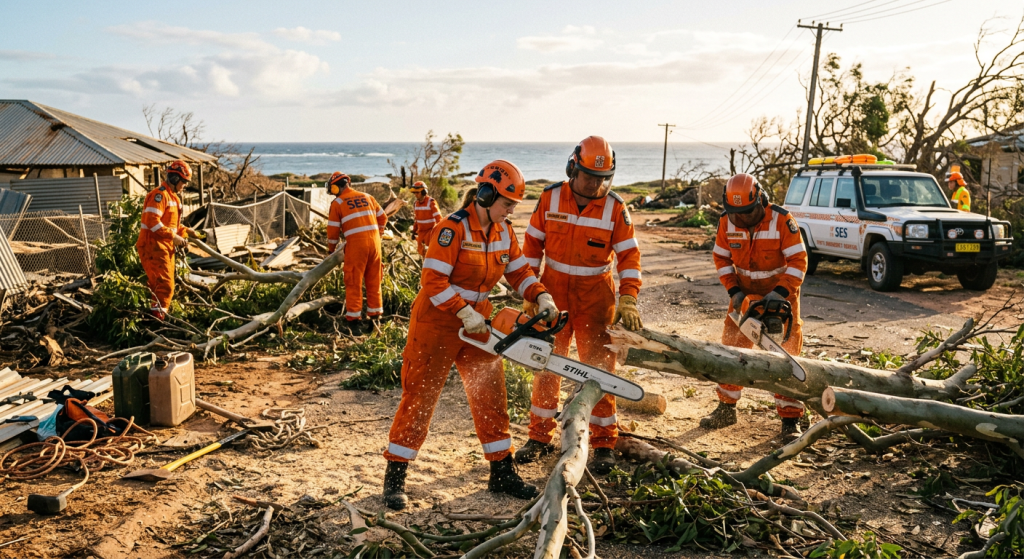
Exmouth, perched on the North West Cape, had taken Narelle's full fury. Winds exceeding 250 km/h had stripped roofs, downed power lines, and scattered debris through every street. The usual sounds of tourism had vanished, replaced by a new rhythm: buzzing chainsaws and neighbours working side by side to restore normality.
The work of recovery
Each morning began with an early safety briefing under a rising sun — a sea of orange protective clothing, chainsaws being fuelled, and priorities being set. Our daily work ranged from debris removal to complex chainsaw operations. Homes and businesses had been battered by gale-force winds, leaving fallen trees draped across fences, roofs, and vehicles.
In several cases, large branches had pierced roofs, requiring combined efforts from Queensland and local SES crews to make properties safe. As road access improved, the operation expanded into nearby communities. My own crew deployed to Bullara Station Stay, where we tackled extensive property clean-ups and removed flood-deposited debris across wide areas of land. Using pumps and high-pressure hoses, we cleared mud and silt from accommodation facilities and the popular Woolshed Restaurant. It was tough, physical work — but with every cleaned space and restored room, each site edged closer to normality.
Reflections on service
Throughout the deployment, teamwork and adaptability were key. Every operator brought valuable experience to the field, and the coordination between state agencies highlighted the strength of national cooperation in disaster response.
Evenings offered a chance to pause and reflect — sitting outside under a sky of endless stars, you could sense the quiet confidence returning to the town. By the time our rotation concluded, significant progress had been made in helping communities reclaim stability. Cyclone Narelle tested resilience across Western Australia, but it also revealed what emergency service volunteers stand for: stepping up, working hard, and supporting people when they need it most.
"As a trainer, these deployments remind me why "Preparing People For Emergencies" isn't just a compliance exercise. It's the difference between chaos and a controlled response when things go wrong."
James is a fire safety trainer at AFP and a Queensland SES volunteer who deployed with the state taskforce during the Tropical Cyclone Narelle response in 2026. He delivers fire warden, chief warden, and evacuation coordinator training across South East Queensland and northern NSW.